
How do we truly inform mountaineering students of the hazards of the mountain they’re trusting us to guide them through?
As guides, we dedicate ourselves to leading people safely through challenging environments. We provide detailed briefings, review objective hazards, and meticulously plan routes. Yet, how do we truly convey the feeling of being in these places, especially when faced with an unpredictable force like icefall? This question weighs on me after a recent experience on Mount Baker’s Coleman-Deming route.
I wrote up the following reflection in my tent after a successful summit attempt on Thursday.
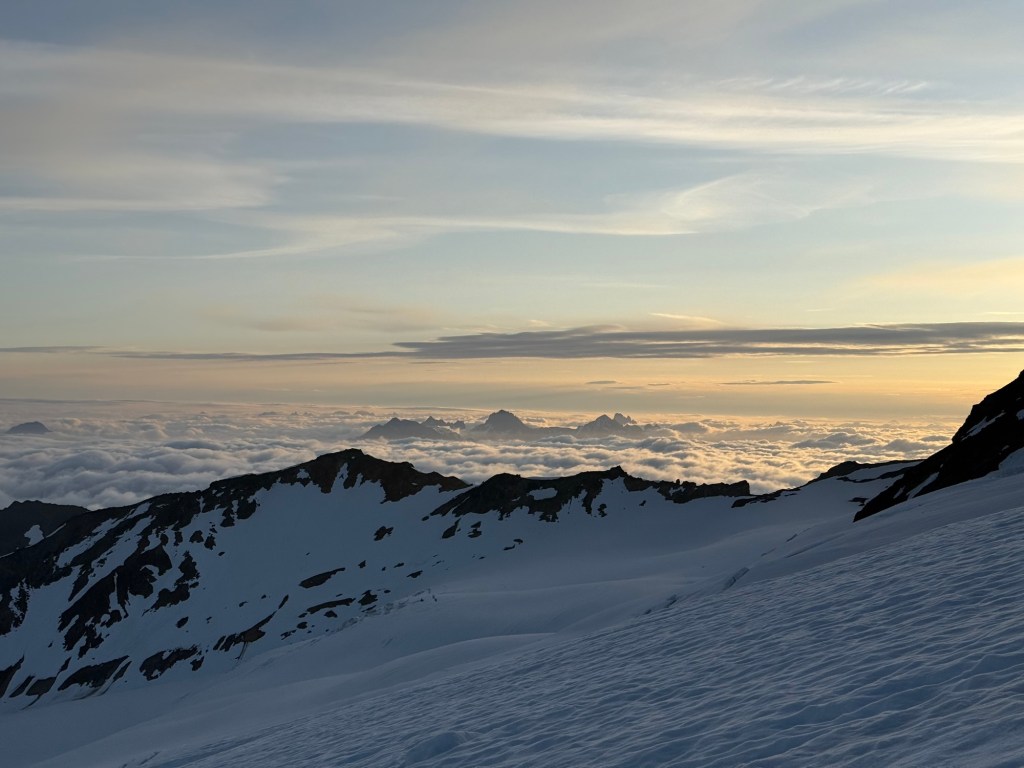
Thursday morning
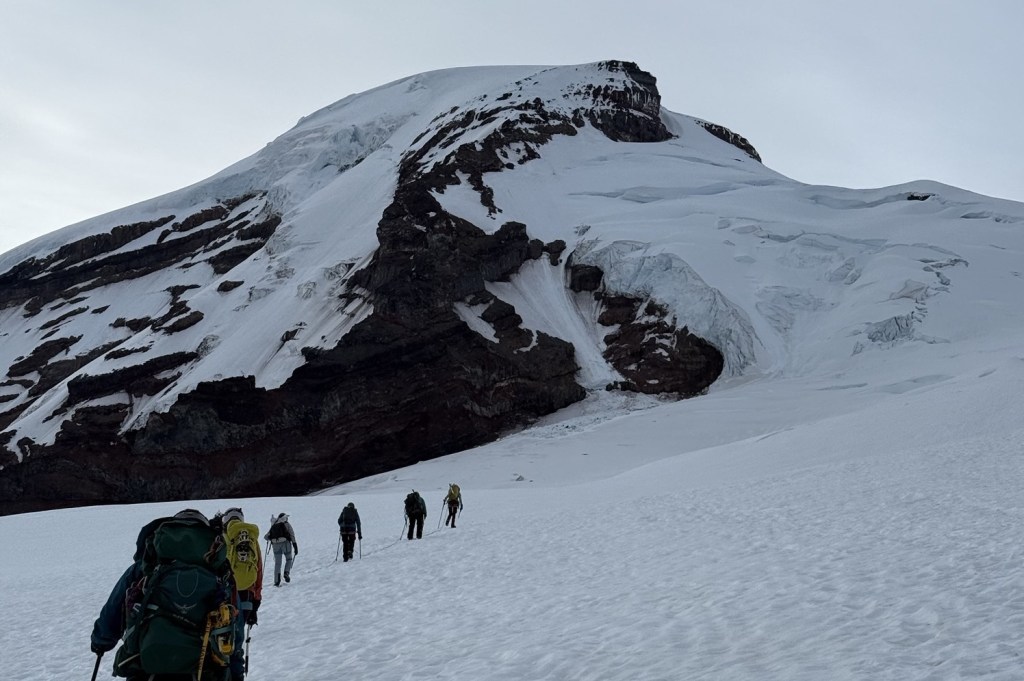
Today, I spent the better part of 13 hours 1-on-1 guiding and coaching a woman up Mount Baker’s Coleman-Deming route. During all this time together, half of which was spent 3 feet apart while I short-roped her on the upper mountain, we discussed all sorts of things, notably what her three children (8, 5, and 3) thought of her leaving for a week to take an Introduction to Mountaineering course halfway across the country. “Don’t die” her eldest told her. She said her 5-year-old is missing her terribly, and her 3-year-old doesn’t yet have a conceptual understanding of what her Mom is doing out here. Surely, I told her, at least the eldest two will be proud to hear of her perseverance and mental and physical strength to keep pushing up to summit Mount baker: 9 hours from low camp to summit.
Understanding the Colfax Icefall
After a dozen-some trips guiding this mountain, I have amassed a detailed pre-summit briefing full of packing lists, advice, and crucially, a rundown of the objective hazards we will face on the summit attempt. We sit in a circle the afternoon beforehand and I discuss in varying detail (depending on the group) our three objective hazards: falling into the mountain (crevasses, moats, bergschrunds), falling off the mountain (sliding off a steep slope or even off a cliff), and the mountain falling on us (rockfall, icefall, and avalanche)
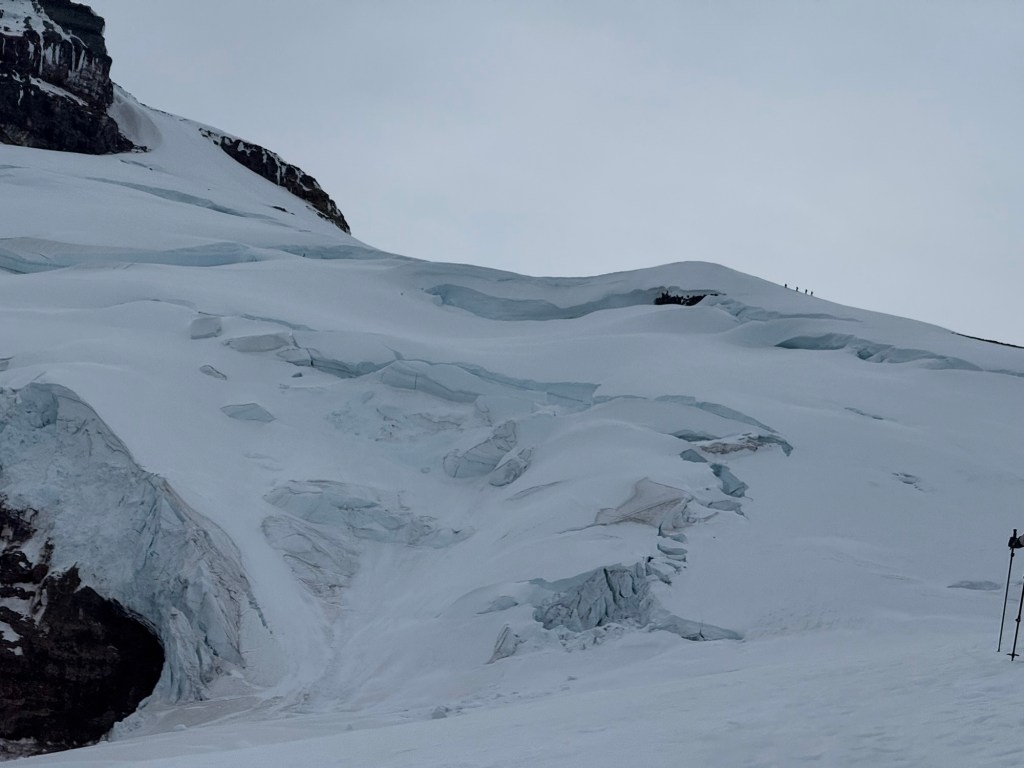
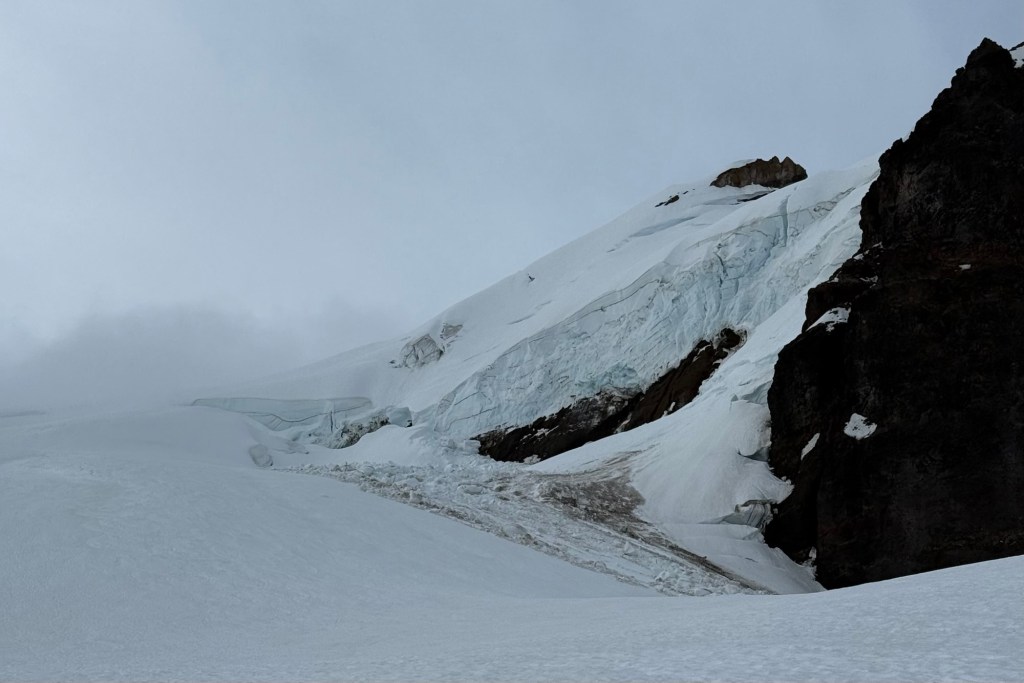
The primary objective hazard on this route is the Colfax ice fall. It unpredictably yet consistently sheds chunks of glacier ice approximately up to 300 feet down onto the glacier below, where the ice rubble can pile up like a heap of dirty laundry, or roll down several slopes, like one impressively garage-sized block that sits some 1000ft from the base of the icefall, next to the climbers route. I’ve heard stories from others and walked through the debris myself, which feels spooky but abstract, hypothetical.
The climbers route travels as far away from these runout paths as possible, however as the season progresses, many crevasses open up nearby, forcing climbers to choose between reducing crevasse fall hazard, or ice fall hazard.
Yesterday, we sat in the safety of camp and discussed how to mitigate the ice fall hazard: we will take a break before the hazard zone, and walk at a motivated clip through this zone (roughly 40 minutes, but with just 2 minutes of the greatest exposure), and since we’re discussing all sorts of other hazards, packing lists and time plans, as usual, everyone nods and looks serious for 3 seconds and moves on to considering our next topic.
Whiteout and Icefall
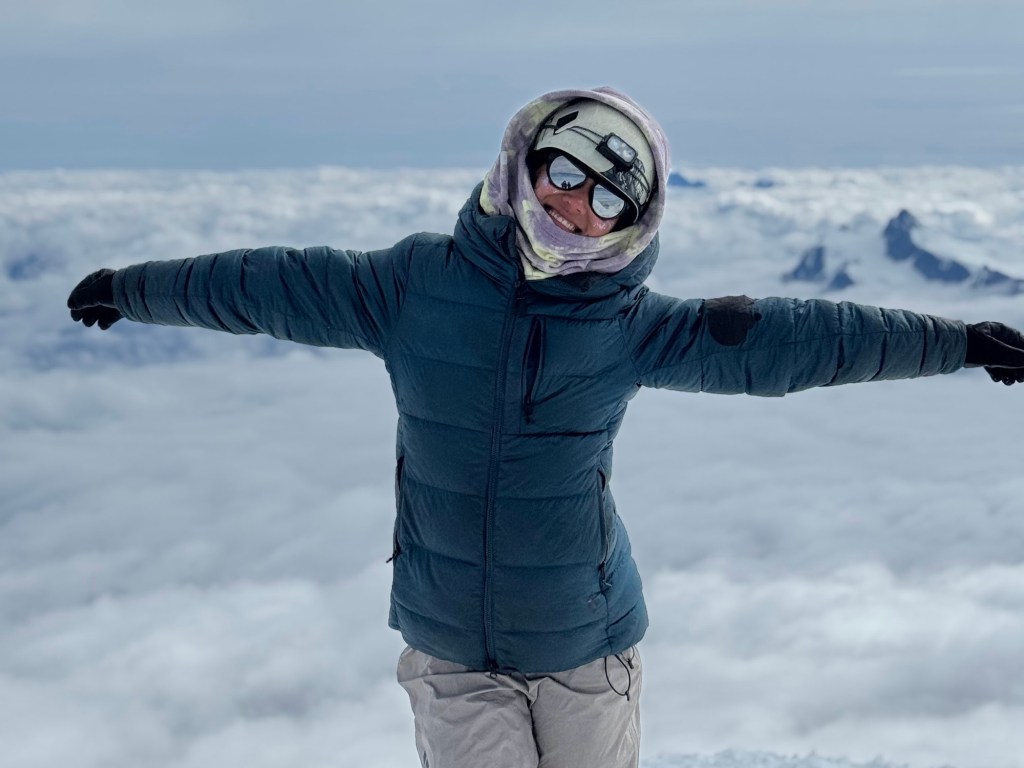
Earlier today, at 11am, our teams just barely made it to the summit, stretching our time plan to the max. The Roman wall on the way up was hard and icy, and we decide it’s worth a slightly longer day to wait for the snow to soften, to have a safer way down. We just had enough visibility for summit selfies with a recognizable background for them to show off to their friends and family, and then we are descending into a cloud, whiteout with visibility as little as 20 feet in front of us, clearing occasionally to see a rock feature below and help us zig zag around. I pulled out my phone multiple times for peace of mind as I confirm our little blue dot location is right on the GPX track we made this morning coming up.
Now, at 2pm, everything is white and foggy, and we’re approaching the start of the icefall zone, when we hear it. And we feel it. It’s the loudest falling sound I’ve ever heard in my time in the mountains. I can’t see, but I know it’s icefall. It lasts uncomfortably long, comes from off to our left somewhere in the mist, echoes and makes us aware of how simultaneously empty of life and full of danger these mountains are. I freeze, remind myself we are not yet in the runout zone, and let myself stand there taking the sound in. I feel it in my chest. It’s close, and the sound starts from above us and finishes below us.
A moment passes and it’s done. Eerily silent now in the aftermath. I feel the panic and tragedy rise up into my throat. It’s almost to my eyes. I want to curl up and cry, for how scared I feel, for how I don’t know where the ice fell, how close we could have been to being hit. A deeper, quieter protest rises in my chest: this is my job and my life. This is what I am repeatedly exposing myself to.
I push everything down. There can be time for that later. Right now, two students and my co-guide are looking at me. I take a deep breath and discuss firstly the objective part. That was ice fall. We’re not sure where. We’re not in danger where we stand currently. We realistically don’t have other options, besides going down and passing underneath quickly. We can’t see in the whiteout but I think I can navigate us farther around the runout zone to provide perhaps a hundredth of a percent less likelihood of icefall hazard. I say this is unfortunately just part of the risk of being in the mountains, a part we unfortunately cannot control in entirety, which is true, but on the inside my mind is already racing through all the choices we made today, yesterday, this week, to understand if there was anything I could have or should have done differently.
Then, the subjective part. I want our group to check in emotionally. I admit I felt fear and it’s still sitting in my chest. I say I want hold space and respect how people are feeling. My co-guide peps us up, reminding us we can do it scared.
The woman I’m climbing with agrees that it’s scary, that she’s scared, and the panic and tragedy wells back up, into my heart and throat, catches my breath, and stops just before I let myself start to cry.
I’m guiding someone’s mother. Three, young, someone’s. When she left, did she know she’d be at a nonzero risk of being hit by massive chunks of ice? How much danger is she really in right now? I don’t have accurate numbers to quantify – no one really does.
In that moment it feels so massively unfair. I feel guilt, like I’ve led people into danger, who perhaps don’t know. Did they understand enough about this mountain to decide it was worth it when I told them to wake up at 1:15am and follow us through this terrain?

I had a client once inform me she wished she’d had more information or expectation of the fear she’d feel walking next to crevasses, looking deep into the abyss. I promptly added that to my next pre-summit debrief. “FAQ: what will it feel like?” With an answer all about the experience of being in the headlamp-lit darkness, 30 feet apart on a rope, and the immensity of the mountain. Often it gets cut from briefing as their mental capacity fills early and we can’t sit there all evening discussing every possible situation.
But I know how to get someone out of a crevasse. And I know a dozen ways to mitigate that hazard, so when I take clients through the crevasse field on this route, I feel rather empowered instead of helpless, anxious and guilty as I do in the moments after the icefall, when I flash upon the absolutely unforgivable and unthinkable possibility of someone not coming home to their family.
We walk at our motivated pace through the worst of the hazard zone. Of course nothing happens. Statistically it is so incredibly unlikely. I could do this every week for 5 summers and not have another close call. Or maybe I would. And what of the 6th? Or 10th?
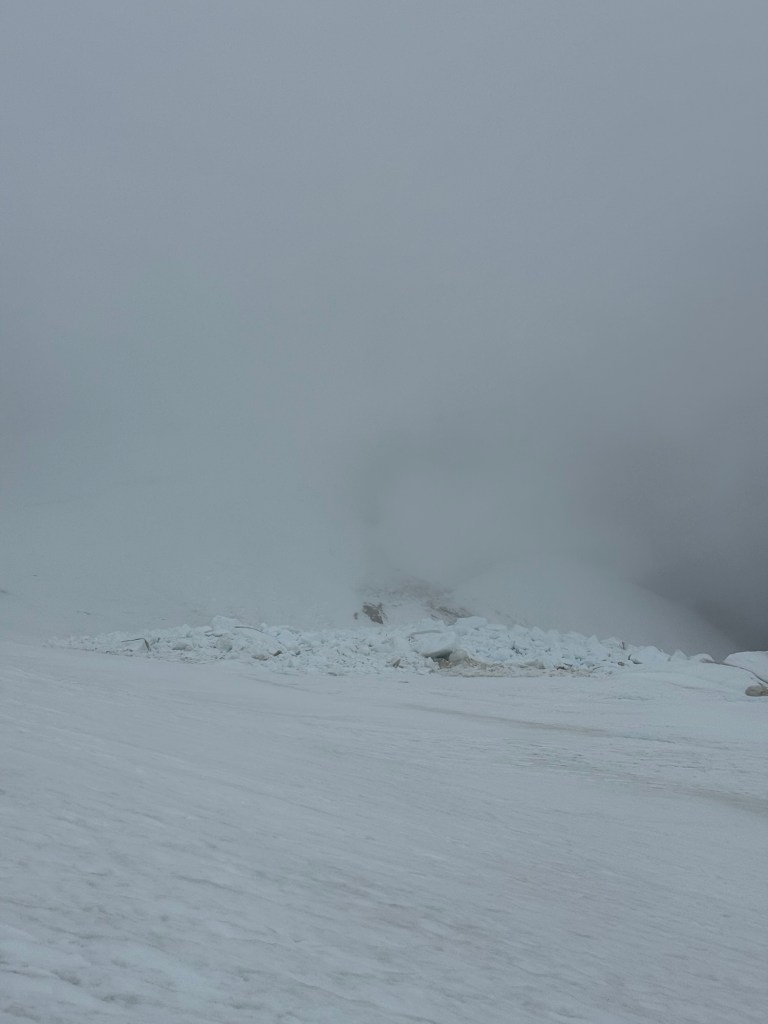
I’m multitasking: squinting through the whiteout for any textures and disturbances in the snow (Is that boot pack? And old ski turn? The telltale sag of a snow bridge over a crevasse? A piece of icefall debris?), and I’m freezing my bare hand off, holding my phone tightly, and double-checking that the blue dot on my map continues to show us circumnavigating as far away from the ice fall, and as close to the crevasses as I dare, with just one student on my rope and limited visibility.
We end up walking perfectly parallel to what looks like a crevasse big enough to drop my van into, about 40 feet away. I realize this and instantly move to change our rope’s orientation to perpendicular to this crack. I direct my student to stay on her track paralleling the crevasse, and I move away, lest we both fall into another closer, parallel crevasse together. I unquestioningly direct her closer to the crack, and myself closer to the icefall zone. She’d be fine if she falls a few feet into a crevasse. I sigh and realize we can’t get any farther from this icefall, and the only way out is truly through.
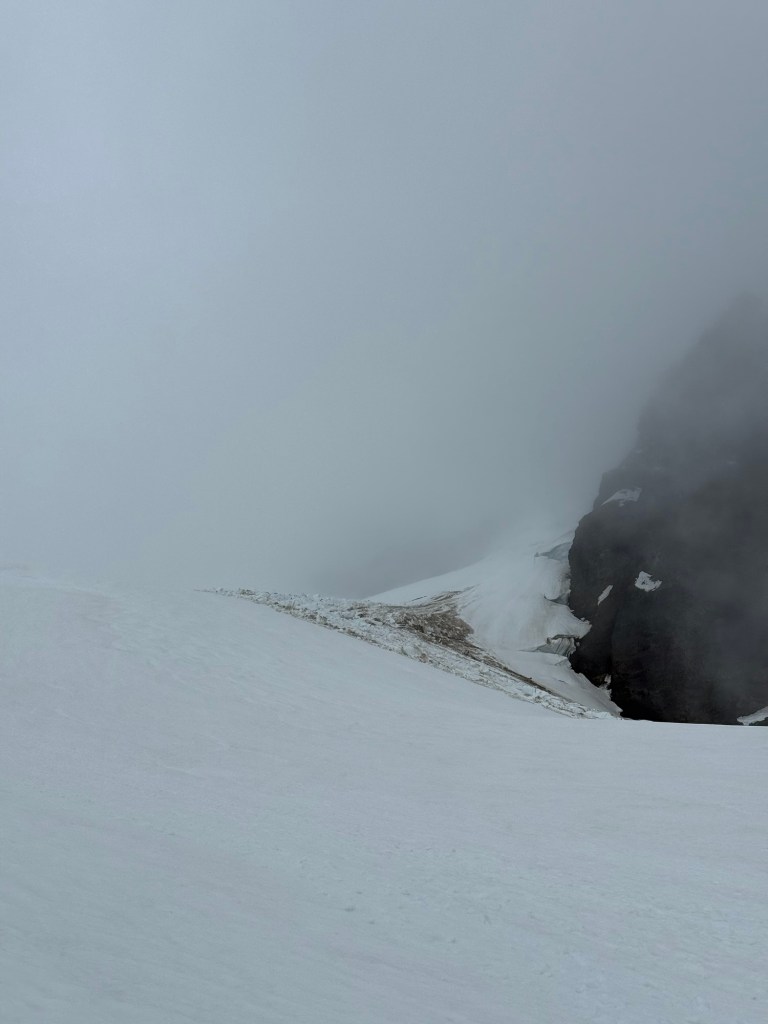
Before we heard the icefall, our team was slowing down, given the magnitude of their effort going up. I had been worried it would be a long trip down. But now, we’re flying. We are going the fastest I have ever walked off Baker with students. And I’m psyched to be moving efficiently, but it’s clear the adrenaline hit and now we are solely focused on getting the hell off this mountain.
Aftermath, Reflections and Next Steps
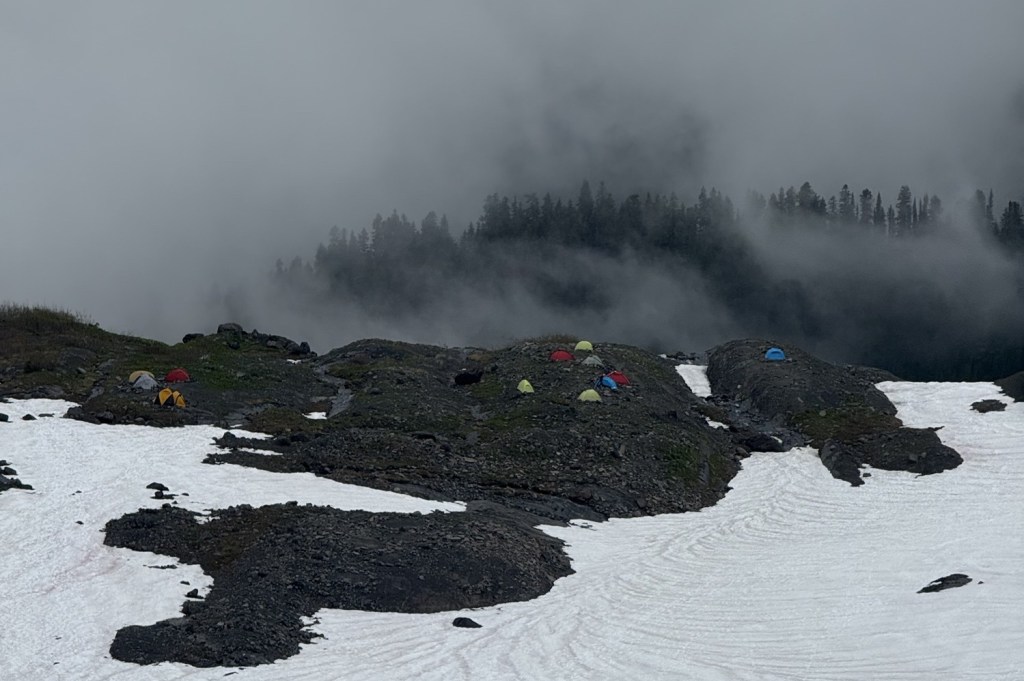
We make it back to camp and I debrief with my co guides: one who was there too, and one who is one of my guide mentors, whose opinion I respect well more than she knows.
She reminds me Colfax sheds unpredictably at all different times of the day, not just with solar exposure, but at night, too. She reminds me that the biggest debris we saw close to the usual climbers bootpack is a few weeks old. My other co-guide reassures me the new debris landed in a pile at the base of the fall and didn’t get anywhere close to where we were going to travel. She pulls out her phone calculator to speculate at how ridiculously low of a percentage chance we had at being caught in dangerous ice fall today.
I contemplate these statements and weigh them with all the emotions I had welling up inside today.
- We’re all back safe. No one actually got anywhere close to icefall.
- We did brief everyone about the icefall.
- At the end of the day, everyone does sign a waiver acknowledging injury and death can result from climbing. And it can also result from driving a car, or single pitch climbing, or being hit by a falling tree branch.
- We’re actually only in a major ice fall danger zone for about 20 seconds, otherwise it’s mild and we’re quite far away.
- The whiteout was scary, greatly adding to our perceived risk, but I could still navigate perfectly fine: from maps, intermittent clearings in the clouds, and memory of the mountain route.
- The sound of the icefall in the fog created a high perceived risk.
I felt scared, and out of control. And that’s hard to admit as a guide, because I want so strongly for everyone in my care to feel safe, to feel held.
Where do I go from here?
My internal conflict comes from two issues: ensuring I have participants’ informed consent of risks, and my own personal risk tolerance given my repeated exposure in this type of terrain.
My goal is never to fear-monger, nor to drone on with endless possibilities until my students’ mental capacity is maxed out. But I must ensure they are truly informed, not simply nodding along. They assume that because they’re with a guide, “nothing bad can happen.” This is a core misconception I will always address now, with gentle intentionality: that icefall along with all the other risks of the mountain are ones we mitigate, but can never fully eliminate.
When we talk about icefall, I’ll articulate how it can sound and feel – intimidating, humbling. But I’ll also offer an alternative perspective: that when the icefall poses no direct hazard to us, being safely out of the way, it’s also an incredible natural phenomenon to witness. Its raw power and immense scale are comparable to the awe of watching the sun rise during an alpine start or standing on the edge of a vast crevasse—a powerful, moving reminder of the earth’s dynamic forces.
Ultimately, my aim is to bridge the gap between these abstract hazards and my lived experience, ensuring everyone on my rope makes a truly informed choice if the summit is worth it for them. Summits are always optional, we can always do something else. Coming home is required.
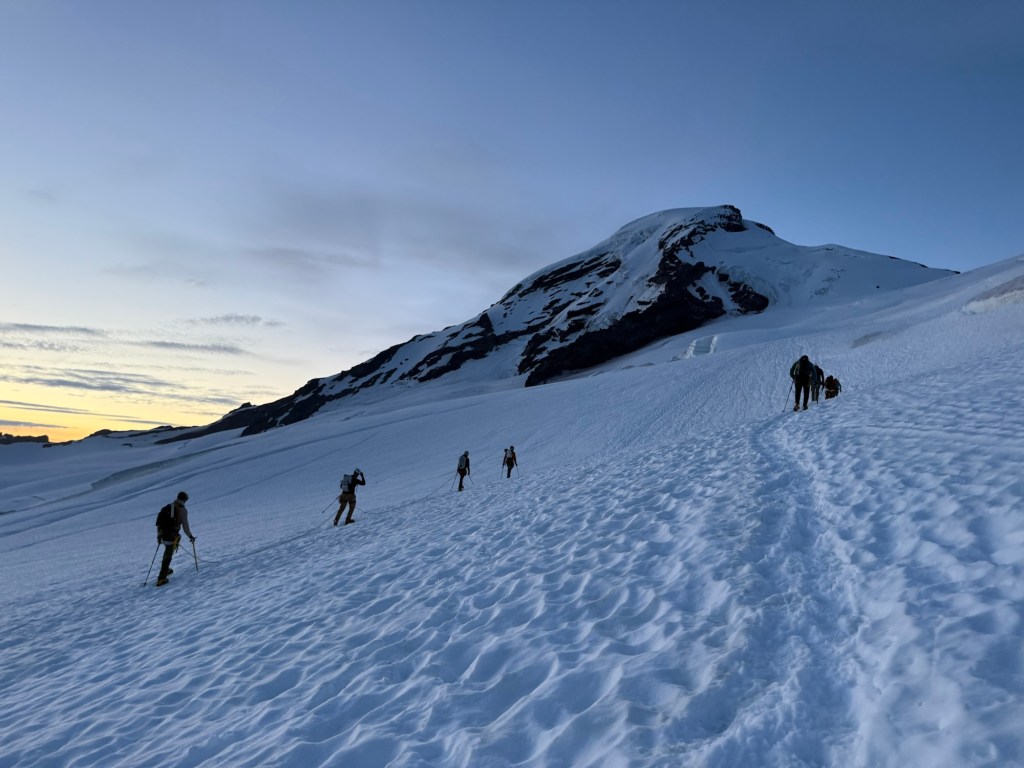
As for my own personal risk tolerance, this lifestyle of guiding and climbing in the mountains, with its inherent risks like repeated icefall exposure, might seem contradictory to some. For me, however, it is still deeply rewarding. The opportunity to share these incredible environments, to witness and support people pushing their limits, and to guide them safely through challenging terrain brings a profound sense of purpose. This reward, coupled with rigorous training and meticulous risk mitigation, aligns with my personal risk tolerance. It’s a calculated engagement with the mountains, where the risks are acknowledged, understood, and deemed acceptable for the unique value this work brings to my life.
Thanks for reading this far! If this post inspired you to get out there, or if you have any questions about the route, leave a comment below or contact me. If you’d like to climb together, you can learn more about me here, and check my availability here.
Subscribe
Follow my blog to have new posts delivered to your inbox.


 Mia Climbs
Leave a reply to David Lapidus Cancel reply